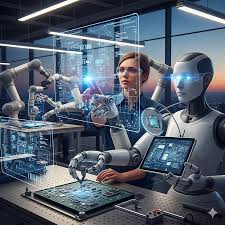
Explore how humans and AI can work together as co-leaders, designing systems that combine human creativity and judgment with AI’s speed and analytical power for smarter, more effective decision-making.
In the last decade, artificial intelligence has evolved from a niche technological curiosity to a pervasive force reshaping industries, economies, and everyday life. Traditionally, AI has been positioned either as a tool that amplifies human capabilities or, in some dystopian imaginations, as a replacement for human decision-making. However, a more nuanced and promising approach is emerging—one that emphasizes collaboration rather than substitution, co-leadership rather than control. This is the concept of human-AI symbiosis, where humans and AI systems are designed to work in tandem, leveraging the unique strengths of each to achieve outcomes neither could accomplish alone.
At the heart of human-AI symbiosis lies the recognition that humans and machines bring fundamentally different capabilities to the table. Humans excel in judgment, contextual reasoning, empathy, and ethical consideration. AI, on the other hand, thrives on processing massive datasets, identifying subtle patterns, executing repetitive tasks with precision, and providing predictive insights at a scale beyond human comprehension. When these complementary strengths are integrated thoughtfully, organizations can create systems in which decision-making is both faster and more nuanced, processes are more adaptive, and innovation occurs at an accelerated pace.
Designing systems where humans and AI co-lead requires a paradigm shift in how we think about technology. Rather than designing AI solely to optimize for efficiency, accuracy, or cost reduction, designers must consider the interaction dynamics between human and machine. This involves rethinking user interfaces, feedback mechanisms, and decision hierarchies to support collaborative workflows. For instance, an AI system may propose a strategy based on complex data modeling, but a human leader can assess the strategy’s ethical implications, align it with organizational values, and adjust it according to real-world constraints that may not be captured in the data. Such an approach ensures that AI augments rather than replaces human judgment, and that the resulting decisions are both informed and responsible.
One critical aspect of human-AI symbiosis is mutual adaptability. Just as humans must learn how to interpret and respond to AI-generated insights, AI systems should be designed to learn from human input. This creates a feedback loop in which both parties continuously refine their understanding and improve outcomes. For example, in medical diagnostics, an AI may analyze thousands of patient images to identify potential abnormalities, while the human physician evaluates these suggestions in the context of patient history, lifestyle, and other nuanced factors. The physician can provide corrective feedback to the AI, helping it improve its predictive models over time. Similarly, AI systems can highlight overlooked patterns or correlations, guiding human experts toward insights they might not have otherwise considered. The result is a symbiotic relationship where human and machine capabilities evolve in tandem.
The design of co-lead systems also necessitates a rethinking of responsibility and accountability. In traditional models, responsibility rests squarely with human decision-makers, while AI is treated as a passive tool. In symbiotic systems, accountability must be shared and transparent. Organizations must clearly define how AI recommendations are used, how decisions are validated, and how errors are mitigated. This requires robust governance structures, including ethical guidelines, audit trails, and monitoring mechanisms that ensure AI supports human judgment rather than undermining it. By embedding accountability into the design, organizations can foster trust in AI systems, which is crucial for widespread adoption and effective collaboration.
Another key factor in successful human-AI co-leadership is cognitive diversity. AI can process information in ways humans cannot, revealing insights that challenge assumptions or highlight alternative strategies. By juxtaposing human intuition with machine-generated analysis, organizations can unlock creative solutions to complex problems. In sectors such as finance, healthcare, logistics, and climate modeling, this interplay has the potential to drive breakthroughs that neither humans nor AI could achieve independently. Cognitive diversity in human-AI systems encourages a culture of continuous learning, reflection, and adaptation, making organizations more resilient in the face of uncertainty and change.
However, designing these systems is not without challenges. One of the most significant is the risk of over-reliance on AI, which can erode human skills and intuition over time. If humans defer too readily to machine recommendations without critical evaluation, decision-making quality may deteriorate, particularly in scenarios where AI models are limited by biased data, incomplete information, or unforeseen circumstances. Mitigating this risk requires intentional design that emphasizes human engagement, critical thinking, and ongoing skill development. Training programs, simulation exercises, and decision-support interfaces can help humans remain active participants, ensuring that the partnership remains balanced and effective.
Trust is another essential element of human-AI symbiosis. For humans to engage fully with AI co-leaders, they must understand the system’s reasoning and limitations. Explainable AI (XAI) is therefore a critical component, providing transparent insights into how recommendations are generated. When users can see the rationale behind AI outputs, they are better equipped to evaluate, challenge, or accept the suggestions. Transparency not only builds confidence but also encourages humans to leverage AI more creatively, exploring possibilities they might not have considered without machine support.
Human-AI co-leadership also opens new avenues for inclusive decision-making. AI systems, when properly designed, can help counteract human biases, expand the scope of perspectives considered, and democratize access to information. For example, in urban planning, AI can analyze traffic patterns, environmental data, and community input to propose infrastructure improvements, while human planners incorporate local knowledge, social equity considerations, and political feasibility. This integration ensures that decisions are both data-informed and socially responsible, reflecting the complex interplay between empirical evidence and human values.
The future of work will likely be defined by increasingly sophisticated human-AI partnerships. From boardrooms to operating rooms, from creative studios to research laboratories, the next generation of systems will require humans and AI to co-lead, co-learn, and co-adapt. Organizations that embrace this symbiotic model will not only improve operational efficiency and decision quality but also unlock new opportunities for innovation, resilience, and ethical stewardship.
Ultimately, the success of human-AI symbiosis depends on intentional design, ongoing collaboration, and ethical foresight. It is not enough to develop powerful AI or to rely on human intuition alone; true co-leadership requires a delicate balance, a mutual respect for the strengths and limitations of each participant, and a shared commitment to outcomes that serve both organizational and societal interests. By designing systems that integrate human judgment with AI capabilities, we can move beyond the simplistic narrative of humans versus machines, toward a future in which humans and AI truly lead together—smarter, stronger, and more responsibly than either could alone.
Human-AI symbiosis is not just a technological aspiration; it is a philosophical and practical framework for designing the future. It challenges us to rethink authority, expertise, and creativity in the digital age. In embracing this collaborative model, we have the opportunity to redefine leadership itself, forging systems where humans and machines co-create, co-decide, and co-lead in ways that maximize the potential of both. The promise of AI is no longer merely automation or prediction; it is partnership, where the combination of human insight and machine intelligence can shape a world that is more informed, adaptable, and just.